SCOTTISH GOVERNMENT UPDATE – REMAIN VIGILANT
REMAIN VIGILANT FOR YELLOW-LEGGED HORNET
The Scottish Government has recently issued the following notice for Scottish Beekeepers.
As you begin to prepare colonies for winter, the Scottish Government Honey Bee Health Team would like to remind everyone to remain vigilant for sightings of the yellow-legged hornet (Vespa velutina), an invasive non-native species that poses a threat to honey bees and other pollinating insects.
While there have been no confirmed sightings of yellow-legged hornets in Scotland to date, incursions continue to be identified elsewhere in the UK, highlighting the importance of continued vigilance and prompt reporting.
At this time of year, hornet colonies require increasing quantities of protein to support brood development and the production of reproductive individuals, resulting in heightened predatory activity around apiaries. One of the most recognisable behaviours associated with yellow-legged hornets is known as hawking.
What is Hawking?
Hawking occurs when hornets hover in front of hive entrances and intercept returning foraging bees. In areas where yellow-legged hornets have become established, sustained hawking activity can place significant pressure on honey bee colonies. Bees may become reluctant to leave the hive to forage, reducing the collection of vital food resources and increasing stress within the colony. Over time, this can potentially weaken colonies and affect their ability to build and maintain adequate winter stores.
As beekeepers carry out final autumn inspections and assess colony readiness for winter, this is an ideal opportunity to observe activity around hive entrances and report anything unusual.
Why is Early Detection Important?
Experience from countries where yellow-legged hornets have become established has demonstrated the importance of detecting and responding quickly to incursions before populations can spread. The success of Scotland’s surveillance efforts depends heavily on prompt reporting from vigilant beekeepers and members of the public.
By reporting suspected sightings, you can help to:
- Detect incursions before nests become established.
- Enable rapid investigation and response by inspection teams.
- Protect honey bee colonies and other pollinating insects.
- Support ongoing surveillance efforts across Scotland.
- Reduce the risk of the species spreading into new areas.
Early intervention remains the most effective defence against the establishment of this invasive predator.
What Should You Look For?
When visiting your apiaries this autumn, please remain alert for:
- Hornets hovering near hive entrances waiting to catch returning bees.
- Multiple hornets regularly visiting an apiary.
- Suspected nests in trees, buildings or other structures.
- Signs of persistent hawking behaviour causing disruption to foraging activity.
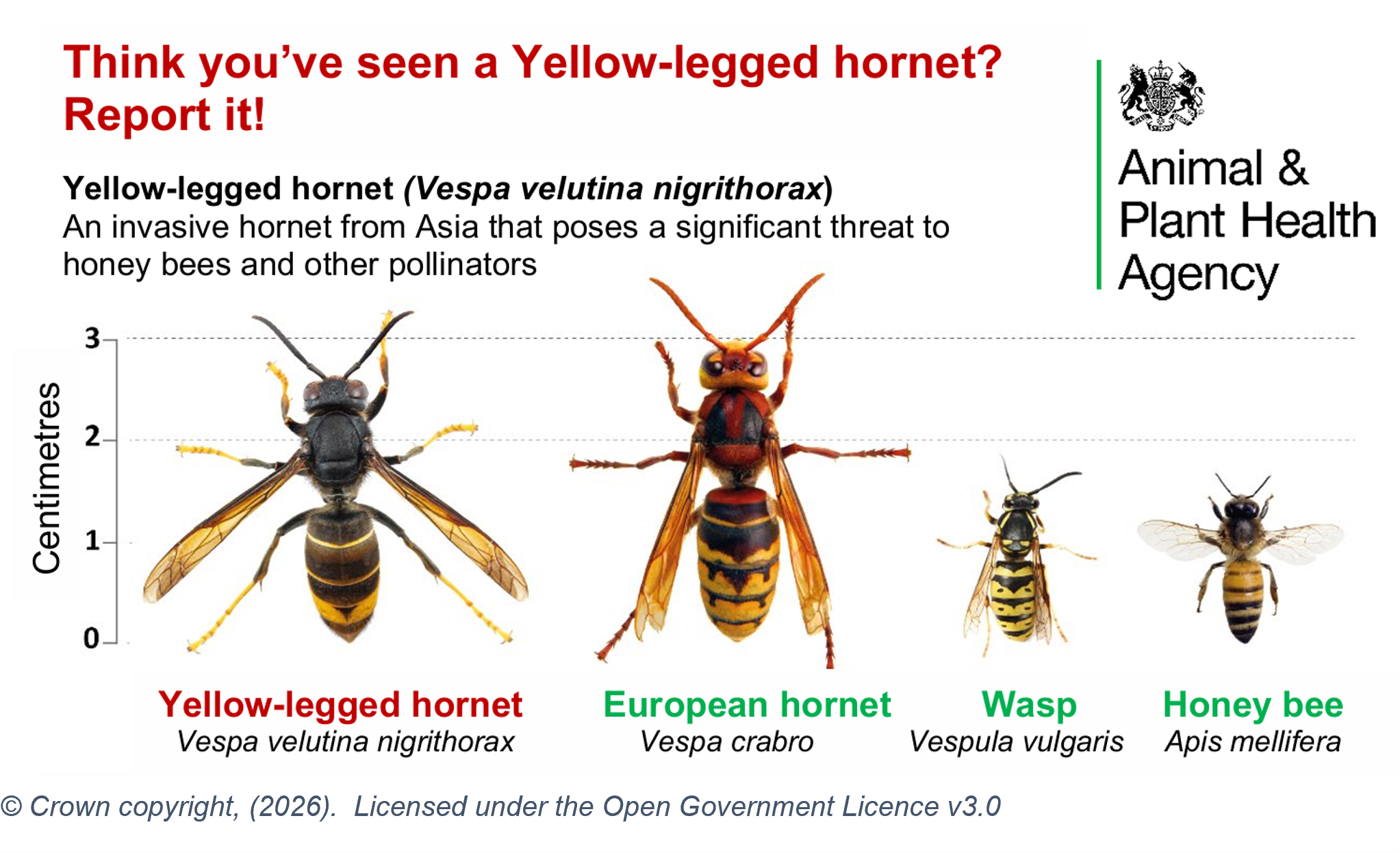
Key identification features of the yellow-legged hornet include:
- A predominantly dark body.
- A broad orange band towards the rear of the abdomen.
- Distinctive yellow legs, particularly the lower sections.
- A slightly smaller size than the native European hornet.
It is important to note that native insects, particularly the European hornet (Vespa crabro), are often mistaken for yellow-legged hornets. For this reason, suspected sightings should always be verified by experts, and photographs are extremely valuable in aiding identification. To download a larger version of the image above please click here. There is also a Confusers poster that may be of use to print off or circulate, just click here.
What Should You Do?
If you observe hawking activity, discover what you believe may be a nest, or suspect that you have seen a Yellow-legged Hornet, please report it promptly and provide clear photographs where it is safe and practical to do so. Timely reporting helps specialists assess sightings quickly and take appropriate action where required.
If you think you have seen a Yellow-legged hornet, please notify the GB Non-Native Species Secretariat (NNSS) immediately. In the first instance, sightings should be reported through the free Asian Hornet Watch App, available for Android and iPhone.
Other methods of reporting the hornet also include using the NNSS online notification form. Finally, you can send any suspect sightings to the Non-Native Species email address alertnonnative@ceh.ac.uk. Where possible, a photo, the location of the sighting and a description of the insect seen should be included. Please only attempt to take a photograph if it is safe to do so.
Preparing for Winter
As this beekeeping season draws to a close, October is an ideal time to review colony health, apiary biosecurity and winter preparations. While carrying out autumn inspections, please remain alert for signs of Yellow-legged hornet activity and continue to share awareness with fellow beekeepers. Early detection and reporting remain our best tools for preventing the establishment of this invasive species in Scotland.
If you have any questions, please contact the Scottish Government Honey Bee Health Team at Bees_Mailbox@gov.scot
Happy beekeeping!
Scottish Government Honey Bee Health Team